

A practical guide to adjusting villa rates with more confidence, while protecting the value of every booking.
Setting a villa’s price can feel straightforward until the calendar starts telling a different story.
Some dates book months ahead. Others remain empty despite enquiries. A holiday week sells quickly, while an ordinary weekday attracts little interest at the same rate.
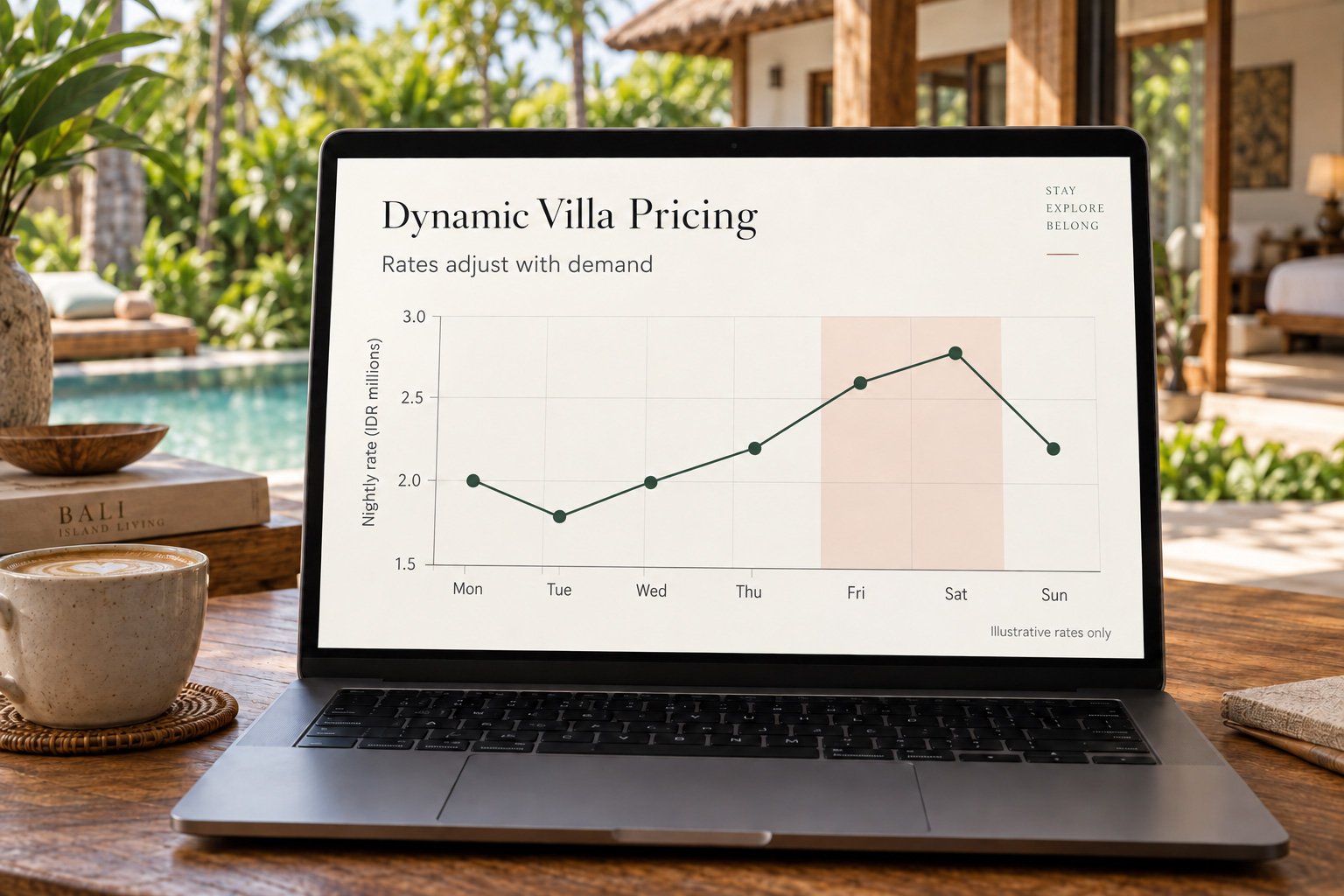
Dynamic pricing helps you respond to those differences. Instead of relying only on fixed seasonal prices, you review what is happening around your property and adjust future rates accordingly.
Used thoughtfully, it can help you earn more from strong dates and make quieter periods more attractive. The starting point is understanding when a price change is useful and when another problem needs attention.
What dynamic pricing actually means
Dynamic pricing means adjusting the rate for an available stay as conditions change.
A villa might offer different rates across the calendar, and the advertised price for the same future date may also change as new information becomes available.
For example, stronger-than-expected bookings could justify reviewing the remaining holiday dates upward. A short gap approaching arrival might need a more flexible offer.
These changes apply to future bookings. Existing confirmed reservations remain subject to their agreed terms.
You can manage this process manually or use software. Pricing systems can recommend rates using market data and property performance, although their methods and available controls differ.
Why villas need a thoughtful approach
An entire villa is usually sold as one unit. Once a date is booked, there may be no additional inventory available for that night.
That makes the shape of the calendar especially important.
A two-night reservation could neatly fill a gap between existing stays. The same reservation, placed in the middle of an open holiday week, could prevent a longer booking.
Villa comparisons also require care. Two properties with three bedrooms may offer very different experiences because of their layout, privacy, access, maintenance, and service.
Useful pricing decisions account for those differences.
Start with a realistic base rate
Your base rate gives the pricing strategy a starting point. It should reflect the villa’s quality, guest appeal, historical performance, and relevant alternatives.
Compare properties that guests would realistically consider alongside yours. Look beyond bedroom count to location, capacity, facilities, reviews, and inclusions.
Then consider your own booking history. Which rates produced worthwhile stays? Which dates sold unusually early? Where did you receive interest without reservations?
Avoid treating a neighbour’s highest advertised rate as proof that your villa can achieve the same price.
Read demand before changing the rate
Look at the dates you are trying to sell and how much time remains.
An empty calendar several months ahead may be normal for a property whose guests usually book closer to arrival. The same calendar two weeks before the stay calls for a different review.
Booking pace helps put this into context. It means comparing how many nights are already reserved with the number you would normally expect at that point before arrival.
Also consider whether holidays or events are relevant to your guests. A nearby event does not automatically create demand for every villa.
If bookings slow, check visibility, availability settings, minimum stays, photographs, and the booking process before assuming the rate is the only problem.
Know when to raise, hold, or lower prices
A higher rate may be reasonable when comparable options are becoming scarce and your dates are selling faster than expected.
Holding the rate may make sense when demand is developing normally and the villa remains competitively positioned.
A reduction may help when arrival is close, suitable demand is weak, and the booking would still make a worthwhile contribution.
There is no universal last-minute rule. Research on Airbnb listings in Ibiza found that increasing prices nearer arrival could reduce revenue, with results varying across properties. That is a useful reminder to follow evidence rather than assume late bookers will always pay more.
Set sensible limits and check the final selling price
Establish a minimum acceptable rate with your costs and commercial goals in mind. Consider commissions, payment charges, guest supplies, utilities, and the cost of preparing the villa for each stay.
A booking that covers its additional costs can help during a quiet period. However, consistently selling at that level will not necessarily cover staffing, maintenance, rent, or ownership costs over the year.
Review discounts carefully too. Airbnb explicitly notes that additional discounts can take the guest’s price below the minimum set in Smart Pricing.
Check the actual offer guests see across your website and booking channels. A sensible rate can become an unintended bargain when several promotions overlap.
Use minimum stays alongside pricing
Sometimes the rate is reasonable, but the stay rules prevent a booking.
If you have a two-night gap and require a three-night stay, lowering the price alone will not make that gap bookable.
Allowing a shorter stay could help, provided the turnover cost and operational effort make sense. During stronger periods, a longer minimum stay may protect valuable dates, but an overly strict rule can also leave the villa empty.
Some pricing systems support different minimum stays for gaps, approaching dates, and other booking conditions. These controls still need to match how your property operates.
A simple illustration of the revenue opportunity
Imagine one villa with 30 available nights in a month.
The figures below are hypothetical. They show how the calculation works, not a forecast or a MAJA client result.
| Measure | Fixed-rate scenario | Adjusted-rate scenario |
|---|---|---|
| Available villa nights | 30 | 30 |
| Nights sold | 18 | 20 |
| Average nightly accommodation rate | IDR 2,000,000 | IDR 2,100,000 |
| Accommodation revenue | IDR 36,000,000 | IDR 42,000,000 |
| Revenue per available villa night | IDR 1,200,000 | IDR 1,400,000 |
The adjusted scenario assumes that a mix of higher rates on strong dates and attractive offers on weaker dates produces two additional sold nights and a slightly higher average rate.
That combination would generate IDR 6 million more accommodation revenue. It does not establish that changing prices will produce those bookings.
The owner would still need to subtract additional operating costs, channel charges, and any pricing-service costs before judging the financial benefit.
Measure more than occupancy
A busy calendar is encouraging, but it tells only part of the story.
Track these measures together:
- Occupancy: sold villa nights divided by available villa nights.
- Average nightly rate: accommodation revenue divided by sold villa nights.
- Revenue per available villa night: accommodation revenue divided by available villa nights.
- Net contribution: revenue remaining after relevant channel costs and variable stay costs.
For consistent comparisons, use completed stays, handle refunds consistently, and separate accommodation revenue from taxes and cleaning charges. Record owner stays and maintenance closures separately so they do not create misleading improvements in occupancy.
Net contribution is not final profit. Fixed business costs still need to be covered.
Let technology support regular review
For a single villa, a structured manual review may be enough to begin. As the number of properties or channels grows, automation can reduce repetitive work.
Whichever approach you choose, review upcoming gaps, unusual rate changes, important dates, and the final prices displayed to guests.
Keep notes when you change rates or stay rules. Over time, those records help you understand which decisions worked and which need adjustment.
The strongest pricing strategy reflects both market conditions and the experience your villa actually delivers. Keep those connected, protect your costs, and judge success by the value of completed stays.
Want a clearer approach to your villa’s pricing? Book a Free Consultation with MAJA Experience to discuss your rates, booking patterns, and revenue opportunities.




Join The Discussion